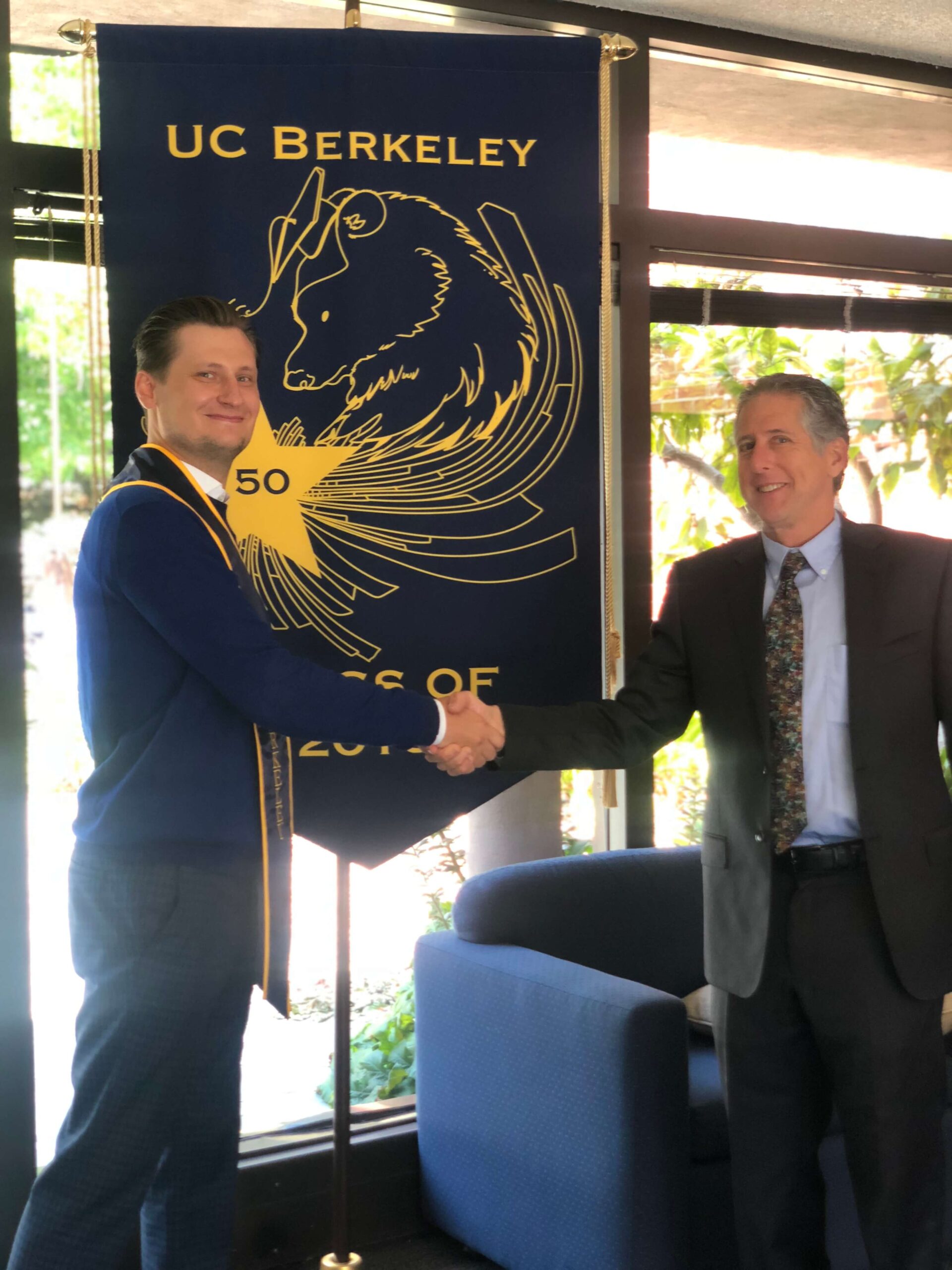
I was looking at this photo. It was taken at UC Berkeley, the moment I shook hands with the Head of the Marketing & Market Analysis program.
To an outsider, this looks like a standard graduation photo. A moment of celebration.
To me, looking back from 2025, it represents the installation of a specific operating system that runs my entire Private Office today.
Berkeley is not a place where they teach you “how” to do things. They don’t teach you the tactics of the week. They teach you First Principles – the physics of why things work. They teach you to reject the surface-level narrative and dig until you hit the mathematical bedrock.
Here is how that academic rigor translates into the way I manage capital today.
First Principles: Deconstructing the Price Tag
In the Marketing Analysis program at Berkeley, we were trained to look at markets not as emotional crowds, but as solvable equations. We learned First Principles Thinking: never accept a truth just because “everyone says so.” You must break a problem down to its atomic elements.
Today, I apply this ruthless deconstruction to Real Estate.
When a broker tells me a property in the Alps or Paris is worth €15 million because “the market is hot,” I reject that statement. That is an opinion, not a fact.
I revert to my Berkeley training. I deconstruct the asset:
- What is the raw cost of the land?
- What is the replacement cost of the concrete and steel?
- What is the regulatory premium?
- What is the liquidity discount?
I don’t believe in “Market Price.” I believe in Intrinsic Value. If the math doesn’t support the narrative, we don’t buy. It is that simple. This scientific approach to an emotional asset class is the direct result of that classroom.
The Protocol of Trust: The Professor and The Deal
The handshake in this photo is significant. It is an ancient protocol. It signifies the transfer of knowledge and the sealing of a bond.
In the digital chaos of 2025, where contracts are signed via blockchain and meetings happen in VR, the physical handshake has become a luxury good.
This photo reminds me of my current role. In my Private Office, I have moved beyond being a “Service Provider.” I have stepped into the role of the “Professor” for my clients.
- My job is not just to execute a transaction; it is to educate the investor.
- I explain the why behind the portfolio strategy.
- I grade the assets with the severity of an academic examiner.
That handshake represents the finality of a process. In university, it was the end of a curriculum. In business, it is the closing of a deal. There is a specific gravity to that moment (the physical confirmation of success) that no digital signature can ever replace.
The Unseizable Asset (High ROI)
The UC Berkeley logo behind me is massive. It is one of the most powerful brands in the world, signaling intellectual rigor and global reach.
But looking at this image, I see the only investment in my life that has generated infinite returns.
Education is the ultimate hedge.
- Governments can tax your property.
- Markets can devalue your stock portfolio.
- Inflation can eat your cash.
But they cannot repossess your mind. The change in scale of thinking that happened in California is an asset that is legally and physically unseizable.
Furthermore, the “Class of…” on that banner represents a Global Network. That diploma is a universal passport. It opens doors in Tokyo, London, and New York. My alumni network is a hidden balance sheet of relationships that I leverage for my clients every day. It is the “Soft Power” that backs up the “Hard Assets.”
The Eternal Student: Theory vs. Reality
University is the Theory. The years since have been the Practice.
There is often a gap between the two. The academic models are clean; the real market is messy.
However, the greatest lesson I took from Berkeley is that graduation does not exist.
We are living in the age of AI and rapid algorithmic shifts. The knowledge I had in this photo was foundational, but if I had stopped learning the day this picture was taken, I would be a dinosaur by 2025.
I operate as an Eternal Student of the Market. I read the market signals with the same intensity I used to study for finals. I treat every potential acquisition as a thesis project that needs to be defended.
In the end, the man in the photo was celebrating the end of a chapter. The man writing this today knows it was just the prologue.