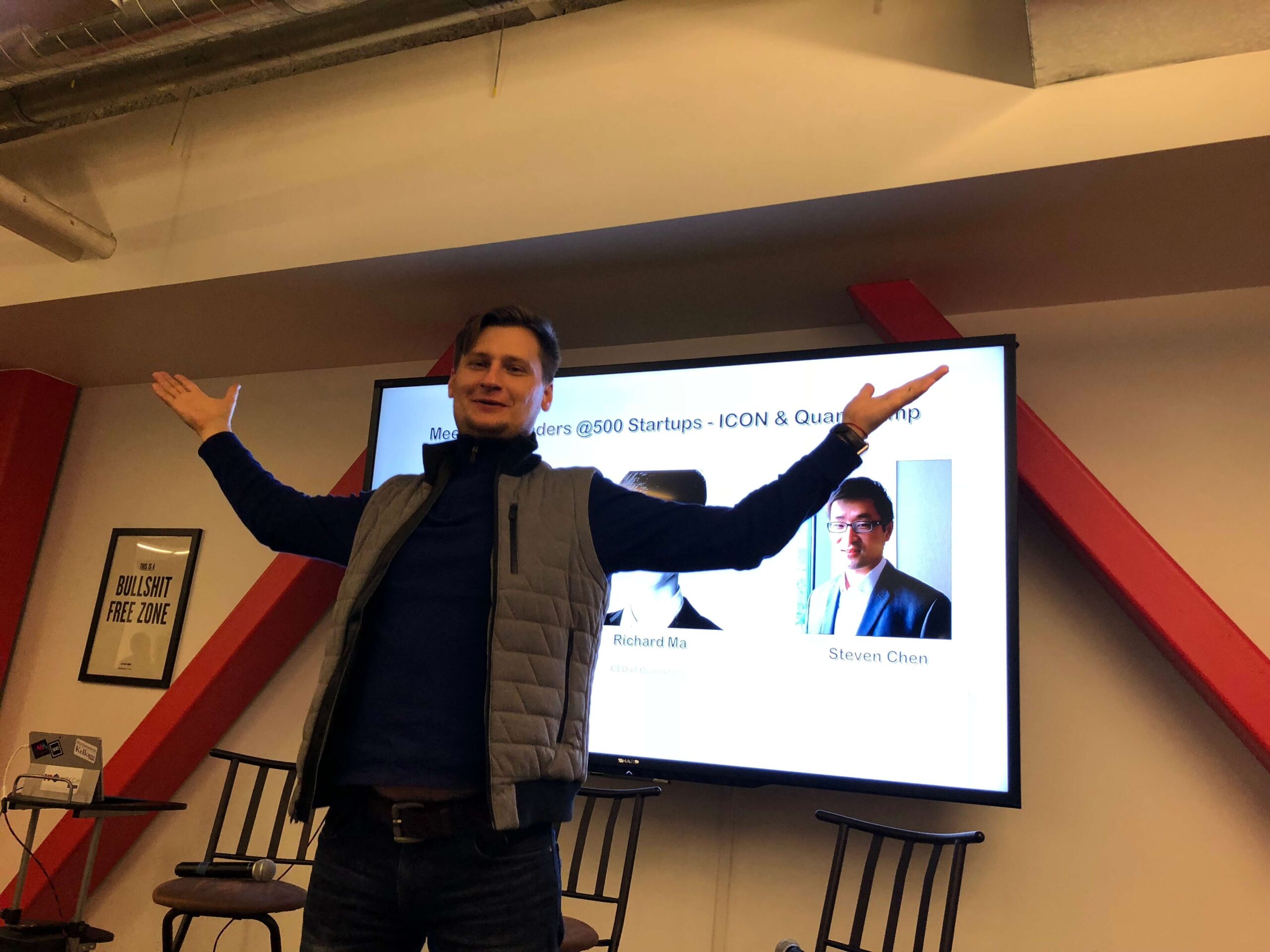
I recently looked at a photo from my days in Silicon Valley. I am standing on stage at 500 Startups, one of the world’s most prestigious accelerators. My arms are wide open, I am pitching a vision, and on the screen behind me are the founders of Quantstamp—pioneers in blockchain security.
But the most important detail isn’t me, and it isn’t the screen. It is the poster framed on the wall to my left.
It reads: THIS IS A BULLSHIT FREE ZONE.
In the startup world, “bullshit” is fatal. If your user retention metrics are fake, you die. If your code has a bug, you get hacked. The market is ruthless and transparent.
Today, in 2026, I operate in a different world: High-End Real Estate and Private Office management in the French Alps. On the surface, it seems like a slower, softer industry. But I quickly realized that the “luxury” market is drowning in the very thing that poster forbade.
It is an industry built on opacity, emotional manipulation, and adjectives.
To build Sutherland Private Office, I didn’t just bring capital from the tech world. I brought the “Bullshit Free Zone” philosophy. Here is how that translates from code to concrete.
1. The War on Adjectives
In Silicon Valley, if you told an investor your product was “stunning,” they would laugh at you. They wanted to know the CAC (Customer Acquisition Cost) and LTV (Lifetime Value).
In real estate, “stunning,” “unique,” and “magical” are the default currency.
I have instituted a strict rule in my firm: The War on Adjectives.
We treat adjectives as camouflage. They are used to hide inefficiencies.
- “Cozy” usually means “Small.”
- “Historic” usually means “Energy inefficient.”
- “Private” can mean “Inaccessible.”
We strip these words from our vocabulary. We replace them with integers. I don’t care if the view is “breathtaking”; I care about the degrees of solar exposure, the thermal conductivity rating of the glass, and the exact yield percentage. We are replacing poetry with physics.
2. Due Diligence as Code Audit
Behind me on that screen in the photo is Richard Ma from Quantstamp. His company audited smart contracts. In crypto, one line of bad code could drain $100 million in seconds. The transaction is irreversible.
Real estate is no different. A bad clause in a deed is a “bug” that can drain your liquidity for years.
Most agents simply read contracts. We debug them.
We approach a purchase agreement the way a hacker approaches a smart contract. We look for the “vulnerabilities”:
- The hidden servitude (easement) that limits future construction.
- The tax liability trigger that fires upon exit.
- The structural “technical debt” hidden behind fresh paint.
We don’t look for reasons to buy. We execute a “penetration test” on the deal to find the one reason not to buy. If the asset survives the audit, then it is safe for our capital.
3. Concrete Unit Economics
500 Startups taught me to view every business through the lens of Unit Economics. Every user is a unit; every unit must be profitable.
I apply this SaaS (Software as a Service) thinking to physical assets.
Most buyers look at the “Price.” Sophisticated buyers look at the “Price per Square Meter.”
We go deeper. We model the asset’s churn (maintenance degradation) and its retention cost (taxes + utilities vs. yield).
We build a dashboard for a chalet the same way I would build one for a software platform. The walls are made of stone, but the management is pure data. If the unit economics don’t balance, no amount of “Alpine charm” can save the investment.
4. From Noise to Signal
In the photo, I am projecting massive energy. I am loud. I am “selling.” In the early stage of a startup, you have to create Noise to get noticed.
Today, my posture has changed.
The “Capital Architect” does not wave his arms. He reads the blueprint.
I realized that in investment, energy is often a distraction. When a broker is excited, when the market is “hot,” when the headlines are screaming—that is all Noise. My job is to filter that out to find the Signal.
The transition from the stage in Silicon Valley to the quiet office in the Alps was a transition from Sales to Advisory. I no longer sell visions. I sell the mathematical certainty that the vision is viable.
5. A Letter to My Younger Self
If I could walk into that room today, tap that young founder on the shoulder, and give him one piece of advice, it would be this:
“Don’t just optimize for speed. Optimize for durability.”
In tech, we worshipped “Fail Fast.” We burned out trying to build things that often became obsolete in three years.
I would tell him: “Build systems that work without you. Build things that cannot be deleted.”
That is why I ended up in real estate. It is the slow game. It is the antidote to the burn-rate culture. But to win at this slow game, you need the ruthless, data-driven, “bullshit-free” mindset of the fast game.
That is the hybrid model of the future: The stability of the mountain, managed with the precision of a microprocessor.