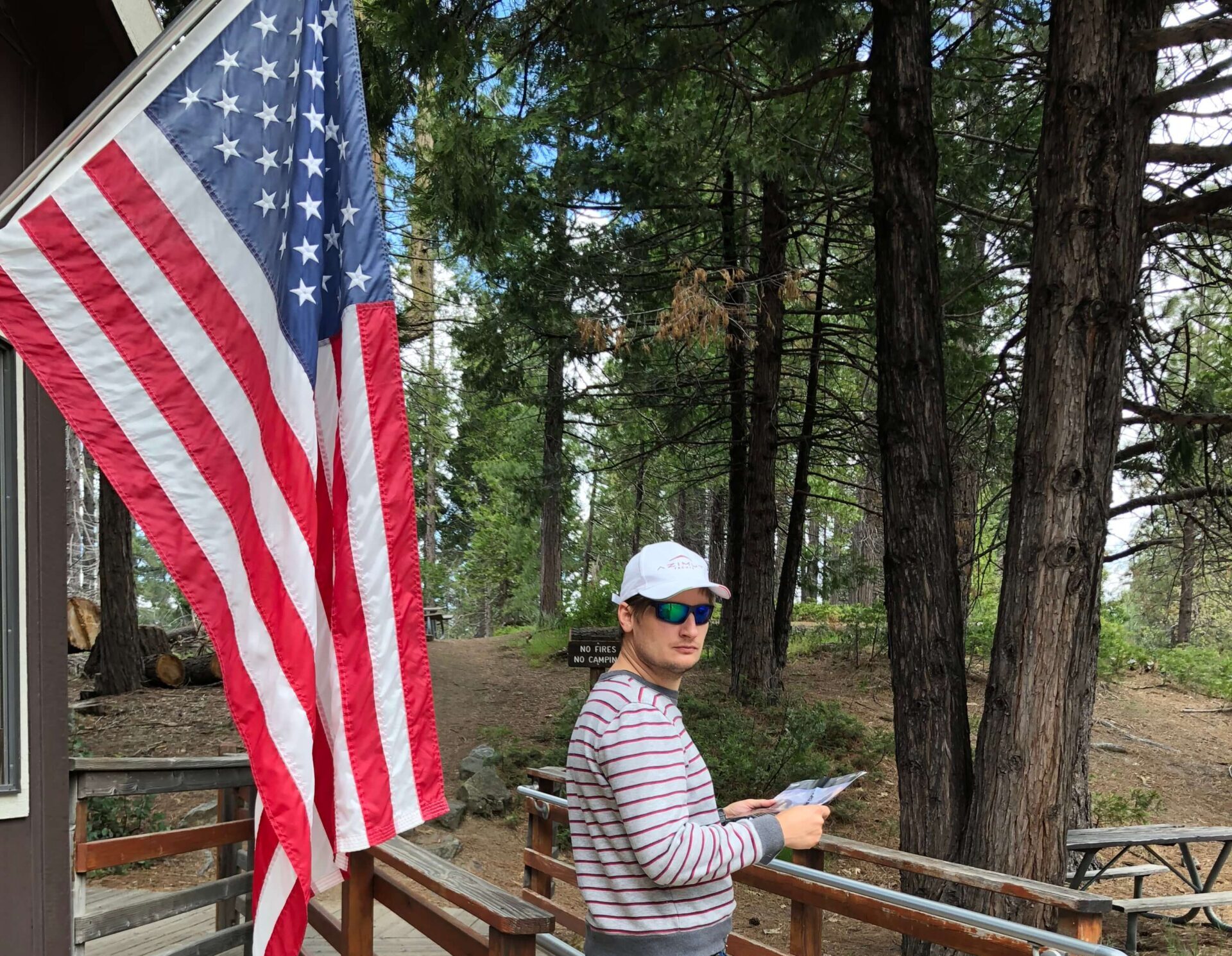
I am looking at this photo taken a few years ago in an American national park.
On the surface, it looks like a typical tourist photo: a man holding a map, standing next to a flag. But looking at it now, I realize this image captures the exact blueprint of the business I have built here in Europe. It represents the collision of two worlds – Silicon Valley drive and European tradition – that defines my Private Office today.
Here are the four strategic pillars I carried with me across the Atlantic.
1. The “Scale” Virus: Exporting Ambition
The American flag in this photo dominates the frame. It is impossible to ignore. That is the primary lesson of the US: Scale.
In Europe, businesses often think locally. A French agency thinks about France; a Swiss family office thinks about the Canton. In the US, even when you are standing in the middle of a forest, you feel the ambition of a continent.
I realized that you can take the founder out of America, but you cannot take America out of the founder.
- The Hybrid Model: My business today operates with the precision of a Swiss watch, but it moves with American audacity.
- The “Virus” of Scale: I brought this mindset to the Alps. We do not just manage properties; we build scalable investment architectures. We don’t look for a “nice chalet”; we look for a portfolio asset that fits a global strategy.
2. “NO FIRES”: The Art of Compliance
If you look closely at the background, there is a small but critical sign: “NO FIRES.”
The forest is dry. One spark could burn down centuries of growth.
This is the perfect metaphor for high-net-worth investment management.
- The Dry Forest: The market is full of “dry” opportunities, undervalued assets waiting to be ignited.
- The Spark: A single compliance violation, a tax oversight, or a legal loophole can destroy a reputation instantly.
In the US, the culture is often “move fast and break things.” But in Wealth Management, “breaking things” means losing capital. My strategy is aggressive in finding the “dry forest” (opportunity), but I am fanatical about obeying the “NO FIRES” signs (compliance). We take risks on the asset, never on the structure.
3. The Bridge: Connecting Two Worlds
I am standing on a wooden bridge. A bridge does not take sides; it connects them.
I view my role in 2026 as that exact structure. I am the bridge between two disconnected banks that usually do not speak to each other:
- The Bank of Technology: The world of data, AI, speed, and disruption.
- The Bank of Real Estate: The world of concrete, heritage, patience, and handshake deals.
It is comfortable standing on the bridge because you have the best view of both sides. Most local players are stuck on one bank: they know real estate, but they fear data. My advantage is that I can walk across.
4. The Strategic Tourist: Silence is a Strategy
I look like a tourist in this photo, but I am focused. I am holding a map. This reveals a “professional deformation” I have never been able to shake: I am always in reconnaissance mode.
Even on a weekend hike, I am analyzing: How does this park monetize? What is the user flow? What is the operational overhead? I don’t know how to just “take a walk.” I scan terrain.
But more importantly, this photo reminds me of where my best decisions come from.
- The Boardroom Fallacy: We think big decisions happen in meetings with lawyers and whiteboards.
- The Reality: My best strategic pivots happened exactly like this: standing in the woods, in silence, with a map in my hand.
In a world of constant digital noise, the ultimate strategic advantage is Silence. You cannot hear your own intuition if you are constantly in a Zoom call. Sometimes, to find the right path for a client’s portfolio, I have to step out of the office, find a bridge, and just look at the map.